Let's Actually Talk About Baby Screen Time — Without the Guilt Trip
Raise your hand if you've ever felt a pang of shame watching your 18-month-old zone out to Cocomelon while you frantically tried to get dinner on the table. Yeah. Same.
Screen time has become one of the most loaded topics in modern parenting — right up there with sleep training and breastfeeding. The messaging from well-meaning pediatricians, parenting blogs, and your mother-in-law tends to land somewhere between "a little is fine" and "you're basically rewiring your child's brain for the worse." No wonder parents are confused.
So let's cut through the noise. What does current research actually tell us about screens and young children? And more importantly, what should you actually be paying attention to — and what can you probably stop worrying about?
What the AAP Guidelines Really Say
The American Academy of Pediatrics is the most cited authority on this topic in the US, and their guidelines have evolved meaningfully over the years. Here's where they currently stand:
- Under 18 months: The AAP recommends avoiding screen use other than video chatting (think FaceTime with grandparents). This is a firm recommendation, particularly for solo, passive screen viewing.
- 18 to 24 months: If parents choose to introduce screens, the AAP suggests high-quality programming and watching together with your child to help them understand what they're seeing.
- Ages 2 to 5: Limit to one hour per day of high-quality content, with a caregiver present when possible.
Those guidelines exist for real reasons. Infants and very young toddlers learn primarily through face-to-face interaction, physical exploration, and back-and-forth communication — what researchers call "serve and return" exchanges. Screens, even educational ones, can't fully replicate that kind of responsive engagement.
That said — and this is important — the AAP has been careful to note that context matters enormously. A rigid "no screens ever" approach doesn't reflect the reality of most American families, and the organization has acknowledged that.
The "Video Deficit" Effect (And Why It Matters More for Babies Than Toddlers)
One of the most well-established findings in this space is something called the video deficit effect. Studies have consistently shown that children under about 2.5 years old learn significantly less from screens than they do from live, in-person interaction — even when the content is identical.
In one often-cited study, infants were taught a new word by either a live person or through a video of that same person saying the same thing. The babies who learned from a real human retained the word far better. The researchers concluded that very young children struggle to transfer what they see on a 2D screen to their 3D world.
This is the core of why the under-18-month guideline exists. It's not that screens are inherently toxic — it's that they're just not a particularly effective learning tool for babies, and time spent on screens is time not spent on the kinds of interaction that actually move the needle developmentally.
By age 2 to 3, that gap starts to close. Toddlers become better at learning from video, especially when content is slow-paced, repetitive, and features a consistent character they've come to recognize. (Yes, this is why Daniel Tiger and Bluey are genuinely better choices than fast-cut YouTube compilations.)
What the Scary Headlines Often Get Wrong
Every few months, a new study surfaces with a headline like "Screen Time Linked to Developmental Delays in Toddlers" — and it sends parents into a spiral. Here's the thing about a lot of that research: correlation is not causation, and the details matter.
Many studies in this space rely on parent-reported screen time, which is notoriously unreliable. Others look at extreme cases — children watching six or more hours a day — and their findings don't necessarily apply to the kid who watches Paw Patrol for 45 minutes while you make lunch.
A 2023 study published in JAMA Pediatrics drew significant media attention for linking higher screen time at age 1 with developmental delays at age 2. But when researchers dug deeper, they found that the children with the highest screen exposure also tended to have fewer enriching interactions overall — suggesting that displacement of quality time, not screens themselves, was the key variable.
This distinction is crucial. The question isn't really "did my baby see a screen today?" It's "did screens crowd out the things that actually matter — talking, reading, playing, exploring?" That's a much more useful frame.
The Circumstances That Actually Change the Calculus
Here's something the one-size-fits-all guidelines don't always acknowledge: family circumstances are wildly different, and they matter.
For a single parent working from home with a 2-year-old and no childcare support, screens are sometimes the difference between keeping the job and not. For a family where a parent has a chronic illness or is managing their own mental health challenges, a few extra minutes of Sesame Street might be what makes it possible to get through the day with patience intact. For multilingual families, children's content in a heritage language can be a genuinely valuable tool.
"I tell parents that the goal is not a screen-free household — it's a thoughtful household," says Dr. Jenny Radesky, a developmental pediatrician at the University of Michigan and one of the authors of the AAP's screen time guidelines. "We want parents asking: what is my child watching, how long, and is it replacing something important?"
That reframe — from rule-following to intentional decision-making — is far more empowering than a hard number on a clock.
Practical Swaps That Actually Work (No Judgment)
If you want to reduce screen time or make what your kid watches more purposeful, here are some realistic strategies that don't require a total lifestyle overhaul:
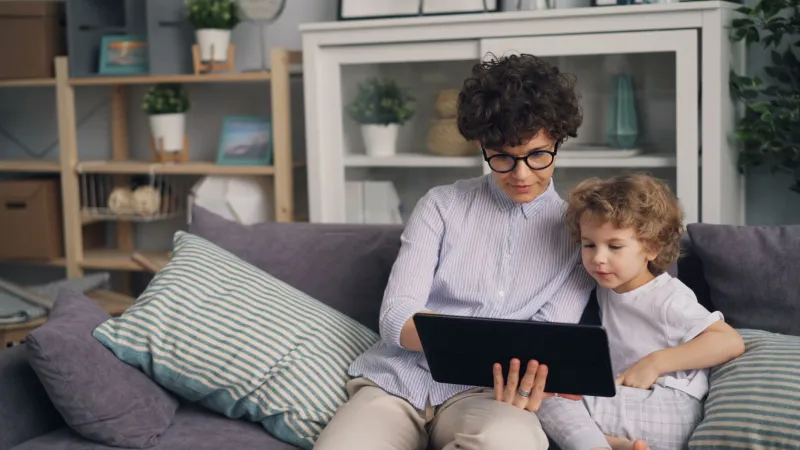
Co-view whenever you can. Watching with your child and talking about what's on screen — "Look, Elmo is feeling sad. Have you ever felt sad?" — transforms passive viewing into an interactive experience. This is probably the single most evidence-backed thing you can do.
Invest in a few open-ended toys. Blocks, stacking cups, play dough, and simple puzzles don't require batteries or Wi-Fi and have strong research support for cognitive development. They don't have to be expensive — dollar store finds work just as well.
Create screen-free anchors in your day. Rather than trying to eliminate screens altogether, designate specific times as no-screen zones: mealtimes, the hour before bed, the first 30 minutes of the morning. These small boundaries can have a big impact without requiring perfection.
Queue up quality content intentionally. Not all kids' media is created equal. Slow-paced, language-rich shows with relatable characters and clear narratives (think Daniel Tiger, Bluey, Sesame Street) consistently outperform fast-cut, highly stimulating content in developmental research.
The Bottom Line
Your kid watching some TV is not going to ruin their development. The research is clear on what does matter: warm, responsive relationships; rich language exposure; opportunities to explore and play; and a caregiver who is emotionally present. Screens, in reasonable amounts, with some intentionality around content, are unlikely to undo any of that.
The guilt you feel when you hand over the tablet? That guilt probably means you're a caring, thoughtful parent who's paying attention. But you don't have to earn that badge by white-knuckling through every moment of the day.
Give yourself a break. Put on Bluey. Drink your coffee while it's hot. You're doing fine.